

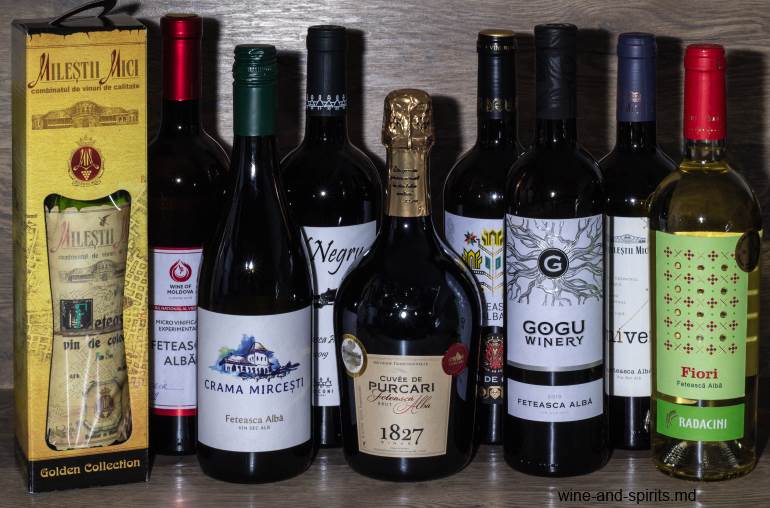
Following the discussion of the technical grape variety Feteasca Albă, it is essential to also speak about the wines produced from it. To illustrate how this variety expresses itself under Moldovan conditions, I assembled 11 samples from different producers and vintages, including a collection wine that turns 35 years old this year.
Traditionally in Moldova, Feteasca Albă is used to produce light, dry wines, as well as base wines for sparkling assemblages. For a long time, there were no single-varietal sparkling wines made from Feteasca Albă. However, in recent years, Cricova has introduced a Feteasca Albă extra-sec produced using the classical méthode champenoise (secondary fermentation in bottle). Another classic sparkling example is produced by Vinaria Purcari.
Cuvee de Purcari Feteasca Albă Brut 2018 (Vinaria Purcari)
Disgorged in December 2019. Alcohol: 12.5%, sugar: 9 g/dm³.

When poured, the wine shows excellent effervescence. Its color is pale straw with greenish hues. Tasted first in a flute glass: the initial nose reveals rye crust; the bouquet shows fruit notes and yeasty pastry tones, while the palate is soft with hints of brioche.
In a wine glass, the bouquet becomes more expressive: toasted rye bread, light citrus notes, apricot kernel, and vanilla pod. Later, green apple and Duchess pear emerge. On the palate – subtle pear notes and lemon zest; the finish shows a refreshing citrus acidity.
When younger, the wine displayed floral and apple aromas even in a flute glass; with age, lees-aging characteristics have come to dominate.
Price: 230 MDL (producer’s website).
Cricova Feteasca Albă Extra-Sec (Cricova)
After a temporary absence, a new batch has returned to the market. Disgorged in May 2021. Alcohol: 13%, sugar: 14 g/dm³.
In a flute glass, the wine demonstrates excellent mousse. Pale straw in color. The initial nose is fruit-floral: ripe apricot and vine blossoms.
In a wine glass, the aroma becomes richer: vine flowers, honeycomb, apple, wildflowers, orange, and fresh sweet pastry. On the palate – orange zest and orange marmalade (less sweet, of course). The finish reveals apricot kernel. The wine is well-balanced (acidity, sugar, alcohol) with pleasant freshness.
Price: 159 MDL (Metro).
Feteasca Albă 2020 (Crama Mircești)
Pale straw with greenish hues and brightness. Initial nose – Duchess pear. Aromas include acacia, vine flowers, lemon, later developing into pear. Silky texture. The palate reflects pear notes; the finish shows lemon zest.
Alcohol: 13% (well integrated). Bottled under screw cap, which is ideal for fresh white wines. Winemaker Arcadie Foșnea indicated a peak drinking window of 2021–2023.
Price: 150 MDL.
Feteasca Albă 2020 Experimental Microvinification NOVW (Speia Vineyard)
Pale straw with brilliance. Initial nose – floral. Aromas include vine flowers, pear candy, acacia, lime, with a background hint of honeycomb and fresh honey. Later, slightly unripe apricot appears. Very fresh aromatic profile.
Silky texture. On the palate – refreshing acidity with lime and green apricot notes. Lime in the finish. Alcohol: 12.4%.
Feteasca Albă, 2020 Experimental Microvinification NOVW (Purcari Vineyard)
Pale straw, bright. Delicate floral nose. Aromas include vine flowers, lemon, acacia, green apple, later green apricot. Silky texture. The palate shows pronounced acidity, pear candy, and citrus notes. Finish: green apple.
Alcohol: 12.3%.
The author of these experimental wines, Elizaveta Bryakhne, noted that due to severe drought, berry development stopped early. Grapes were harvested with relatively low titratable acidity, but during fermentation acidity increased and pH decreased – without correction. This highlights the importance of studying the impact of climate conditions on grape and wine composition.
Feteasca Albă 2019 Experimental Microvinification NOVW (Speia Vineyard)
Pale straw with brilliance. Initial nose – dried herbs. Aromas include vine flowers, fig, and spicy herbs. Noticeable acidity gives the wine a “crisp” character (6.7 g/L, pH 2.99), yet the texture remains delicate.
On the palate – a slight spicy bitterness; on the second day, pear candy notes emerged. Alcohol: 12.75%.
Fetească Albă 2019 IGP Codru Limited Edition (Cricova)
Pale straw with greenish hues. Initial nose – Duchess pear. Aromas include pear candy, vine flowers, acacia, ripe peaches. Bright and fresh profile. Delicate texture.
On the palate – citrus and pear notes; finish – orange zest and pear. Alcohol: 12.5%. A very pleasant, easy-drinking wine.
Price: 135 MDL (Metro).
Univers Feteasca Albă 2019 (Mileștii Mici)
Pale straw with greenish hues. Floral-citrus-pear aromatic profile. Immediately appealing with fresh, expressive aromas: pear, lime, wildflowers, meadow herbs, vine blossoms, later jasmine.
Silky texture. Lime on the palate; finish shows slight lime zest bitterness. Alcohol: 12.5%.
An excellent value for money. Highly recommended.
Price: 70 MDL.
Sol Negru Feteasca Albă 2019 (Asconi)
Straw-colored, bright. Initial nose – pear and flowers. Aromas include spices, honeysuckle, tropical fruits, and basil notes. Very expressive.
On the palate – citrus and pear; finish also pear. On the second day, rose and basil dominated, making it reminiscent of Viorica.
This is a more opulent style, less typical for Feteasca Albă, where subtlety is expected. Tropical fruit notes are unusual and likely yeast-derived. In blind tasting, it would be difficult to identify it as Feteasca Albă. Nevertheless, it is a well-made wine. Alcohol: 12%.
Price: 110 MDL.
Feteasca Albă 2019 (Gogu Winery)
Pale straw with greenish hues. Delicate floral nose. Aromas of pear, acacia, honeysuckle, lemon zest, briefly tropical fruit, later apricot. After 30 minutes, floral notes recede, giving way to citrus.
Silky texture. On the palate – lemon zest and pronounced acidity; finish – apricot kernel. Alcohol: 13%.
Price: 120 MDL (currently unavailable).

Fiori Feteasca Albă 2019 (Radacini Wines)
Pale straw with greenish hues. Floral-citrus nose. Aromas include vine flowers, wildflowers, lemon, green apricot, fresh grapes. Floral character remains dominant.
Silky texture. On the palate – pear candy with slight sweetness; finish – lemon zest. Alcohol: 13%.
Price: 140 MDL.
Feteasca Albă 2018 (Vinuri de Comrat)
Pale straw. Fresh, delicate floral nose. Aromas include wildflowers, light orange notes, pear; later honeysuckle and apricot. After an hour – white carnation and fresh grape pulp.
Refreshing palate with good acidity, citrus and pear notes, and floral nuances. Finish – pleasant citrus bitterness transitioning into pear. Alcohol: 13.5%, well integrated.
A good wine for its price.
Price: 70 MDL.
Feteasca Collection Wine 1986 (Mileștii Mici)
Bottled in 1989, bottle No. 329. Nearly 35 years old.
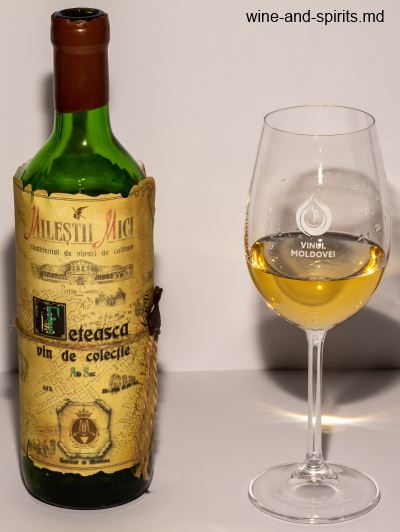
Admittedly, opening this bottle was nerve-wracking – dry wines of this age can be spoiled. However, this Feteasca has aged beautifully.
Golden color. Initial nose – baked apples and toasted walnuts. Over time, aromas of cinnamon pastry, rye crust, yellow raisins, almond, and apple strudel develop. A slight sherry note fades with aeration.
Oily texture. On the palate – nutty notes; finish – light bitterness. Alcohol: approx. 10%.
This wine is a true time capsule, shaped by decades of complex chemical evolution.
Price: 375 MDL. Best tasted at the Mileștii Mici underground cellars.
A Word of Caution
Inspired by this example, one might wish to age Feteasca Albă for 20–30 years. However, most wines are not designed for such longevity and will deteriorate within a few years. The 1986 example was carefully selected, aged in oak vats, and monitored over decades – making its longevity exceptional.
Conclusion
The aromatic profile of Feteasca Albă typically features floral notes – vine blossoms, wildflowers, acacia, jasmine, honeysuckle – and fruit notes such as apricot, pear, lemon, lime, and apple. Tropical fruit aromas are not characteristic and usually result from yeast selection.
Feteasca Albă rightfully deserves to become one of Moldova’s signature wines and a popular summer choice. In my opinion, screw caps are preferable to preserve freshness. It is essential to promote the variety, expand vineyard plantings with local clones, and increase its presence both domestically and among tourists.
Given that the variety is relatively easy to cultivate and vinify, Feteasca Albă wines should remain affordable. A good pricing strategy will support their popularity. While export markets may present challenges, within Moldova these wines should be widely consumed.
Related articles:
Feteasca Albă Grape Variety in Moldova: New Findings
