

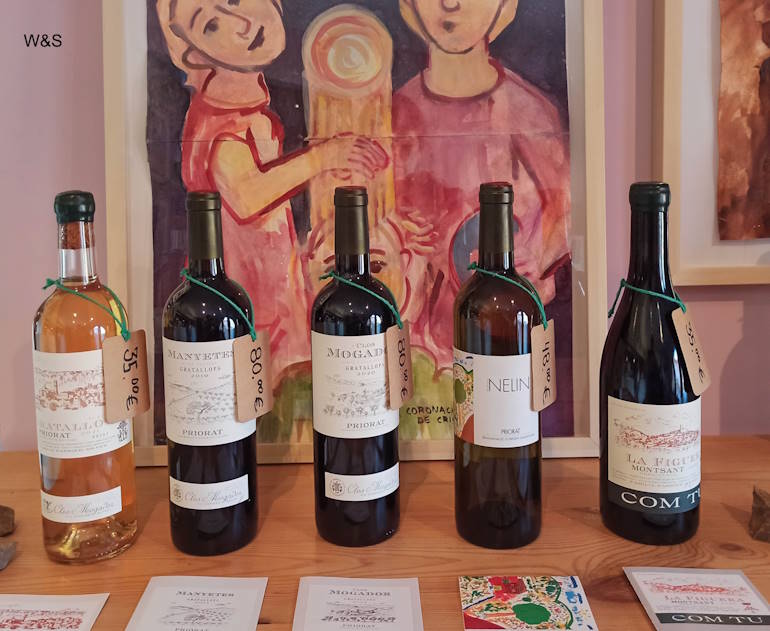
Continuing my story about “Clos Mogador”, I would like to tell you about the wines produced there. I was fortunate enough to discover them during a tasting on my visit to the winery. “Clos Mogador” produces just five wines, with total production amounting to approximately 50,000 bottles.
As I mentioned in my previous article, the grapes are harvested into 10-kg crates. At the winery, they are cooled in a refrigerated room before processing. The bunches are sorted on a conveyor belt, and individual berries are then removed on a vibrating sorting table. Each wine has its own production method, but fermentation takes place in oak vats for all of them. The producer states that only natural yeasts are used.
The tasting featured five wines from the same vintage, 2022, allowing us to see how a particular year is reflected in different wines. This was a special year because it marked the beginning of a prolonged period of drought. However, in 2022, the vines still had water reserves accumulated during the previous year, which meant that the harvest was a good one.
The Tasting
Gratallops Vi de Vila Rosat, 2022
“Vi de Vila” means that the wine is made from grapes grown within the territory belonging to a particular village. In this case, that village is Gratallops.
This wine challenges the conventional perception of rosé wines as light and fruity. During the tasting at the winery, everyone who tried it could not help exclaiming: “Is this rosé?” I must admit that “Gratallops Vi de Vila Rosat” surprised me more than any of the other wines. In 2024, “Gratallops Vi de Vila Rosat”, 2022 was recognised as the best rosé in Spain.
At some point, the founder’s son, winemaker René Barbier Meyer, realized that rosé wines could be made with the same seriousness and approach as white or red wines. Determined to create a rosé that would break the stereotype of it being merely “fruity”, René and his younger brother Christian took the idea very seriously. They selected a site with polyculture and a high level of biodiversity and planted a vineyard where biodynamic and regenerative farming methods are practiced. Their first rosé was produced in 2021.
The blend consists of Garnacha/ Grenache (60%), Carignan (20%) and Macabeu (20%). All the varieties were fermented together. The wine was aged for 12 months in 2,000-litre barrels and for a further six months in stainless steel tanks.
According to its creators, Garnacha brings a Mediterranean character to the wine, giving it body, intensity and an oily texture. Carignan contributes acidity (and therefore freshness), fruity softness and alcohol. Macabeu, meanwhile, serves as a kind of “backbone” for the wine, enabling it to withstand extended ageing in wood and, in subsequent years, in the bottle. It is difficult to disagree with this assessment.
The bouquet had already begun to reveal notes of strawberries and pickled vegetables, followed a little later by smokiness, subtle Brettanomyces notes, leather, oak and oriental spices. The palate is refreshing, with fruity and spicy nuances and a slight salinity. Alcohol: 14%.
Indeed, “Gratallops Vi de Vila Rosat” is a serious wine, not a rosé meant to be enjoyed for just one summer, as rosé wines are often perceived. Of course, a wine like this requires more time to get to know and appreciate.
“Robert Parker’s Wine Advocate” awarded it 94 points, the same score given to both its first vintage (2021) and its most recent one (2023).
Manyetes Vi de Paratge, 2022
“Vi de Paratge” means that the wine is made from grapes grown in a specific natural micro-site.
Manyetes is the name of an area in Gratallops where climatic conditions are extreme. It is almost a desert, yet Carignan manages to survive there. According to René Barbier Ferrer, acquiring a vineyard with such low yields was therefore an irrational and emotional decision. On the other hand, this vineyard expresses its terroir like no other and produces a unique and exceptional wine. It has been made since 1999, becoming the second wine in the “Clos Mogador” portfolio (a full ten years after the first!).
“Manyetes” is made from 100% Carignan. It is vinified using different techniques, combining whole berries (carbonic maceration) with crushed ones in order to express its essence as fully as possible. During alcoholic fermentation, 40% whole grape stems were added to the must with skins. One portion of the wine was aged for a year in 600-litre oak barrels, while another portion was aged in four glass demijohns, followed by a further eight months in demijohns.
The wine would benefit from aeration, as it is clearly very rich, intense and concentrated. “Manyetes” expresses the character of powerful vines struggling against drought and has considerable ageing potential.
The bouquet features aromas of overripe dark fruits, particularly cherry and plum, along with sloe, black chokeberry, cream, white pepper and graphite dust (reminiscent of a ground pencil lead).
The palate is lively and juicy, with notes of fresh fruit and a touch of minerality. The fruitiness carries through into a long finish. The wine has a slender, well-defined body. Alcohol content: 13.5%. “Manyetes”, 2022 is already fully ready to drink. There is no need to wait for further ageing; it can be enjoyed now.
“Robert Parker’s Wine Advocate” rated this wine 95 points.
Clos Mogador Vinya Classificada, 2022
“Vinya Classificada” means that the wine is made from grapes grown in an outstanding vineyard with unique terroir characteristics, comparable to a Burgundy Premier Cru. “Clos Mogador” is the winery’s flagship wine, which René Barbier Ferrer describes as the soul of Priorat in a bottle. Its first vintage was produced in 1989.
The blend consists of Garnacha (45%), Carignan (29%), Syrah (16%) and Cabernet Sauvignon (10%).
During fermentation, 30% whole grape stems were added to the must with skins. Maceration lasted between 35 and 65 days, depending on the vessel. The wine was aged for 18 months in 2,000-litre oak foudres.
Initially, the wine is quite closed. It clearly needs to be decanted. “Clos Mogador”’s bouquet is characterized by a fruity profile, with aromas of cherry, blackberry and blackcurrant, complemented by spices, including anise, cinnamon, black pepper and dried herbs. I am sure that after spending several hours in a decanter, the wine will become much richer and more intriguing.
The palate is fresh and fruity, with a touch of minerality and slightly sweet, velvety tannins, but the wine is absolutely dry, with residual sugar of just 0.3 g/l. The finish is long, with fruity nuances. Alcohol: 14%.
Critics’ scores: “Robert Parker’s Wine Advocate” – 97 points; “Wine Enthusiast” and Tim Atkin – 96 points each; James Suckling – 95 points.
Nelin, 2022
“Nelin” has been produced since 2000. It was the first wine created jointly by father and son, René Barbier. It represents the family’s vision of white wine from Priorat.
Its creators explain that much of the wine’s distinctive character comes from the fact that the vineyards (four plots) supplying the grapes for “Nelin” are located at different altitudes, ranging from 350 to 500 metres, have different exposures and feature a wide diversity of grape varieties. The wine contains nine varieties! Why so many?
Nelin” has always been made with Garnacha Blanca (around 60-70%) and Macabeu (20 -25 %), and the rest, a small percentage, of different varieties. At the beginning, those varieties were foreign: Rossane, marsal, viognier, Pinot noir. But we realized that they did not adapt very well to the terroir, and so we moved onto other varieties, autochthonous ones, such as Cartoixà, Picapoll Blanc, Escanyavella, Pedro Ximenez and others. They contribute different aromas and levels of acidity, making this wine noticeably different from conventional Garnacha-based white wines,” explained René Barbier Meyer.
And so, “Nelin” came to include Garnacha Blanca, Macabeu, Pansal, Picapoll Blanc, Cartoixa, Trepat Blanc, Cariñena Blanca, Pedro Ximénez (PX) and Escanyavella.
Escanyavella, for example, is a rare white indigenous variety from Catalonia (Spain), grown mainly in Priorat. Its name translates from the Catalan dialect as “old lady strangler”. The variety acquired this nickname because of its thick skin and extremely high, aggressive acidity. It is said that eating one of these grapes can cause a severe cough or a tickling sensation in the throat. However, at “Clos Mogador”, they decided that Escanyavella gives the wine a firm structure and, thanks to its acidity, ensures its longevity.
When making the wine, the winemakers drew inspiration from the old “Brisats” style. In Catalonia, this is a traditional orange wine produced by fermenting the must with the skins. Fermentation of the must together with the skins in oak barrels lasted more than six months. The ageing period was 18 months: 12 months in 1,200-litre barrels and a further six months in stainless steel tanks.
Thanks to the extended skin contact, the wine acquired a vivid yellow colour.
At first, it is rather closed. A little later, an interesting and complex bouquet begins to unfold, with notes of spices, honey, apples, baked quince, dried white flowers and herbs used as seasonings. A delicate, fresh hint of lemon emerges through these warm aromas.
The wine is full-bodied and rounded, but fresh on the palate, with hints of fruit, spices and minerality. The finish is long, with spicy nuances. Alcohol content: 14%.
Robert Parker’s Wine Advocate awarded Nelin 96 points, Tim Atkin gave it 95, and James Suckling rated it 94.
Com Tu La Figuera, 2022
The “Com Tu” project in the Montsant region was conceived by Anderson Barbier, who was adopted by Isabel and René when he was four years old. He works in IT but also wanted to try his hand at winemaking alongside his brothers and father.
The vineyard is located in the village of La Figuera, in the high-altitude part of historic Priorat. The soil here is different: red clay and limestone.
The climate in La Figuera and Gratallops differs considerably because of the difference in altitude. La Figuera is located on a mountain peak, acting as a kind of “guardian” of Priorat, whereas Gratallops lies in a more sheltered, hilly area that heats up considerably in summer. La Figuera is significantly cooler due to its elevation.
There is also a sharp contrast between daytime and nighttime temperatures in La Figuera. The nights are cold even at the height of summer, which slows down grape ripening and preserves high acidity. In Gratallops, by contrast, the overall temperature range is more moderate, encouraging earlier and more complete phenolic ripening of the grapes.
The “Com Tu” project has a social dimension in addition to its winemaking ambitions. “Clos Mogador” wants to help develop the village and raise awareness of DO Montsant. This region surrounds the famous D.O.Q. Priorat appellation in a horseshoe shape.
The vineyards occupy three plots at altitudes of 580–600 metres. The vines are between 50 and 80 years old. Garnacha (Grenache) expresses itself particularly well in this terroir: the wines are fresh, delicate and mineral.
“Com Tu” is made from 100% Garnacha. During vinification, 40% of the grapes were kept whole, while the rest were crushed. The wine was aged for one year in old 4,500-litre oak foudres, followed by a further eight months in concrete tanks.
“Com Tu La Figuera” stands somewhat apart in the “Clos Mogador” portfolio. Its style is different. Compared with the other wines made from grapes grown in Gratallops, it is more understandable and friendly. The first vintage was produced in 2015. In 2021, Anderson left the project, and a new label was designed for the wine, featuring an image of the village of La Figuera.
The wine opens up beautifully. Its bouquet reveals aromas of violets, cherries, raspberries, blackcurrants, orange peel and liquorice, along with spicy notes.
It has a juicy, fruity and lively palate, with hints of herbs-seasonings, and an expressive, long finish. An excellent wine. Despite its alcohol content of 14.5%, “Com Tu” feels more easy-drinking than “Clos Mogador”, and especially “Manyetes”.
Robert Parker wrote that “Com Tu”, 2017 reminded him of Grenache from Châteauneuf-du-Pape.
Robert Parker’s Wine Advocate, Tim Atkin and James Suckling unanimously awarded “Com Tu La Figuera”, 2022 a score of 94 points.
Some questions
From the descriptions of “Clos Mogador”’s wines, it is clear that they are not trendy, they are not fashionable. They are intended for people who understand wine and take a genuine interest in it. Moreover, Priorat is a region primarily known for its red wines. However, consumers have recently been looking for lighter, fresher wines. This prompted me to ask: “Why do you produce white and rosé wines that have been aged in oak? Lately, consumers have been looking for lighter, fresher wines. Aging adds complexity to a wine, but how easy are these wines to sell?”
In our case, we wanted to make this profile of rosé, not a light wine, but a complex wine, that can be consumed with food. A rosé that can age and improve with time. We only produce around 3.000 bottles a year, and we sell them all. We actually cannot fulfill all the orders, so we intend to increase the production in the future,” explained René Barbier Meyer.
Another question arises: given the global decline in demand for red wines, is the producer experiencing difficulties selling them?
So far, we consider ourselves fortunate because we keep selling all of our wines. But we have to consider that our production is pretty small, and we have faithful clients from many years ago,” says the head of “Clos Mogador”.
My conclusion is that when wines express the uniqueness of their terroirs, they are exclusive and cannot be subject to the influence of fashion or the whims of consumers. They are valuable in their own right, timeless.
Related articles:
“Clos Mogador”: The “Adventure” That Changed the History of Priorat
DOQ Priorat: From Abandoned Vineyards to Iconic Wines
