

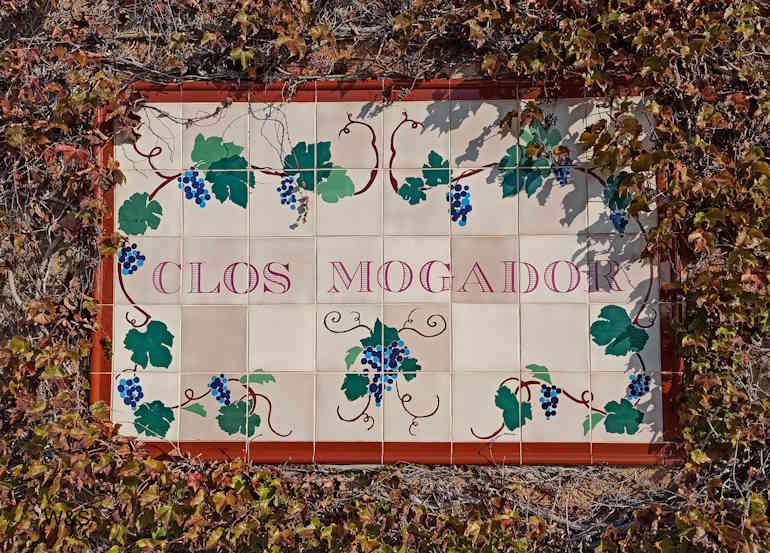
The story of modern winemaking in Priorat began with this producer, and it has been an extraordinary success. It also confirms the role of the individual in shaping history. One man, René Barbier, managed to create the momentum that set an entire region on the path to development. And this process continues to gather pace. I visited Priorat and its legendary “Clos Mogador” estate.
Who Is René Barbier?
The Barbier family had been involved in viticulture since the 13th century. In Provence, in the Vaucluse department, they owned a large estate called “Le Martinet”. However, when the phylloxera epidemic broke out in France, the estate fell into decline. In 1880, Léon Barbier, the great-grandfather of René Barbier Ferrer (the founder of “Clos Mogador”), moved with his family to Tarragona, Spain, where phylloxera had not yet arrived. There, he founded the “René Barbier” SA wine company, naming it after one of his sons.
When phylloxera reached Priorat, some small and medium-sized producers managed to survive by joining cooperatives. These cooperatives sold wine in bulk to major export companies and wine brokers, including the Barbier family business. In the 1940s, René Barbier’s sons, Léon and René II, began bottling the first wines from Priorat. However, the premature death of René II, the father of René Barbier Ferrer, led to the collapse of “René Barbier” SA.
Léon Barbier’s great-grandson, René Barbier Ferrer (René III), was born in Tarragona in 1950. He studied oenology in Burgundy and Limoux, France, and gained practical experience at prestigious French wineries, including “Pétrus” and “Château La Fleur Pétrus” in Bordeaux. In Spain, René worked for “Palacios Remondo” in Rioja, whose owner was a friend of his. The owner’s son, Álvaro Palacios, would later become one of René’s closest collaborators in the revival of winemaking in Priorat.
In 1979, Barbier and his wife, Isabelle Meyer, acquired their first estate in Gratallops, where vineyards, olive trees and almond trees were growing. This marked the beginning of the creation of “Clos Mogador”, an estate that would achieve worldwide recognition. René believed that the region possessed unique conditions for producing the wines he dreamed of making.
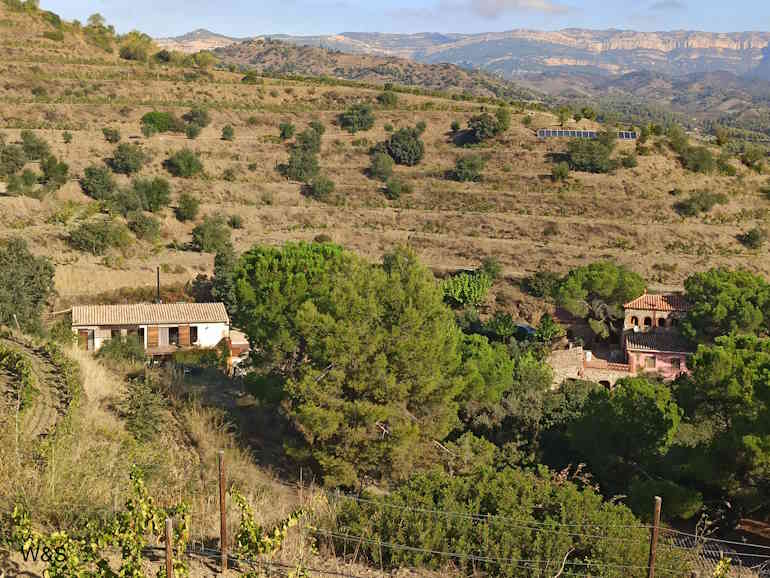
They liked the area so much that they even built a house for themselves at the foot of one of the hills where their vineyards were located. Later, René and Isabelle built a new house further up the hill. One of their sons built a house nearby, where he lives with his family. They generate their electricity using solar panels.
What Does “Clos Mogador” Mean?
The name “Clos Mogador” comes from the French term “clos”, used mainly in Burgundy, which means “a vineyard surrounded by a wall” or an enclosed vineyard plot.
“Mogador” is the name of a fictional estate in the famous novel “Les Gens de Mogador” (“The People of Mogador”), written by French author Élisabeth Barbier, who was also René Barbier’s great-aunt. The novel describes the lives of several generations of one family. The estate was inspired by “Château Le Martinet”, which had belonged to the Barbier family’s ancestors since the 16th century.
Priorat Needs Romantics
According to René Barbier, anyone who wanted to get involved in this business had to be a romantic and a rebel like him, because conditions here were extremely challenging. What attracted him to this place above all was the absence of “chemistry”. Local agriculture seemed to have stopped developing, as if it were waiting for better times.
When he started making wine, his only goal was to produce a top-quality wine that would be better than Burgundy’s. However, ten years of hard work passed before the first wine was produced, thanks to the joint efforts of a group of like-minded people (they were nicknamed the hippie group) whom René managed to attract to Priorat. Each of them owned a plot of land on which they planted a vineyard. However, the grapes they harvested were processed together in a single vat. The wine was then divided among them, and each producer sold their share under their own brand.
It turned out that the production cost of this wine was very high. The winemakers had to set an ex-cellar price of €9 (equivalent to 1,500 pesetas in the national currency). At that time, this was an unrealistic price for Spanish wine, and even more so for wine from Priorat, since the region was virtually unknown. It was impossible to sell the wine at that price even on the domestic market. Export was essential.
René travelled to Paris to meet Jean-Claude Jambon, who held the title of “World’s Best Sommelier 1986”, and asked him to taste his wine. After tasting it, Jambon ordered two cases. Meanwhile, the entire 1989 vintage was purchased by an American importing company that brought “Romanée-Conti” wines into the United States. This happened after the company’s representatives had been shown Priorat’s terroir from the heights of the Montsant mountains.
The wines of Priorat gained real recognition thanks to Robert Parker. He first rated a wine from this region in 1993, when he tasted René Barbier’s “Clos Mogador” (a blend of the 1989 and 1990 vintages) and awarded it 92 points. From then on, Robert Parker, followed by his successors at “Wine Advocate”, as well as many other renowned critics, rated “Clos Mogador” wines almost every year, awarding them high scores.
The Vineyard Soils
Today, “Clos Mogador”’s vineyards cover 40 hectares. The grapes harvested there produce approximately 50,000 bottles of wine across five labels.
From the outset, René Barbier was fascinated by terroir. He believed that the place where the grapes are grown determines the identity of the wine. That is why the estate pays so much attention to its vineyards. They are located in three areas: “Mogador”, “Manyetes” and “Nelin”. The vines are tended according to the specific characteristics of each site.
The aim of vineyard management here is to find a balance between Priorat’s wild nature and agriculture. The objective is to allow the vineyards to function freely, with minimal intervention.
Since 2012, “Clos Mogador” has been implementing biodynamic farming methods in its vineyards, with the aim of giving more back to the land than it takes from it.
Since Priorat has extremely poor slate soils (more details here), they need to be enriched. The estate uses cow manure compost and biochar to provide the soil with the minerals and microorganisms necessary for its health.
The soil beneath the vines is worked lightly with the help of mules to ensure better distribution of the compost. Since this region receives very little rainfall, without this cultivation the compost would not reach the roots of the vines.
Cover crops are also maintained on a permanent basis. In addition, “Clos Mogador” works with Pedro Parra, a renowned Chilean terroir consultant whose projects extend around the world, to conduct in-depth soil analysis. This makes it possible to adapt both vineyard practices and winemaking processes to the specific characteristics of each terroir.
The oldest vines are 80 years old.
Grape Varieties
“Clos Mogador” grows the following red grape varieties: Garnacha Tinta (Grenache), Carignan, Syrah and Cabernet Sauvignon.
The white varieties include Garnacha Blanca, Macabeu, Pansal, Picapoll Blanc, Cartoixa, Trepat Blanc, Carinyena Blanca, Pedro Ximénez and Escanyavella.
Vine Training
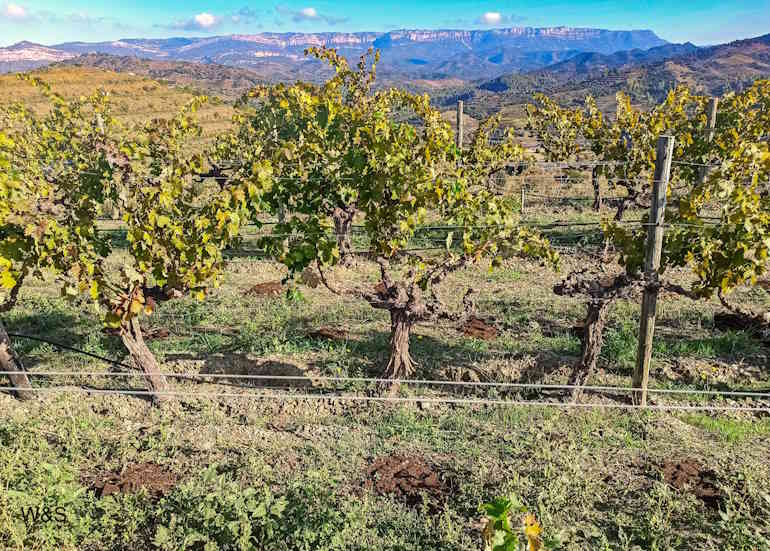
The vineyards have a distinctive appearance: each vine grows independently. Why is this? And why don’t they use European training systems such as Guyot? Christian Barbier Meyer, who is responsible for vineyard management, explained:
This is the way they used to grow in the region for many, many years. And, after trying different methods, we have seen that it’s what works best. We do not use the Guyot system. We did use it in a small plot during a certain period of time, but we stopped. It did not work very well in this poor soil, and with little rain.
We perform formative pruning according to the Simonit & Sirch method at all our estates in order to extend the lifespan of the vines and avoid making multiple cuts in the same place. The entire team receives this training, which we refresh annually, adapting it to each year’s climatic conditions”.
For reference:
The Simonit & Sirch method is an advanced, internationally recognised technique of “gentle” or careful vine pruning. It has revolutionised viticulture. The method is used by leading wineries around the world, including “Château d’Yquem”, “Château Latour”, “Moët & Chandon” and “Louis Roederer”.
Vineyard Treatments
The principles of regenerative agriculture define our approach to vineyard treatments. The key distinction lies in our motivation for treatment: we do not aim to solve problems but rather to prevent them by strengthening the vines’ immune system and fostering their natural balance. To achieve this, we employ biofertilizers and phytotherapy, all produced by us in our bio-factory.
We utilize plants cultivated in our garden, such as nettle, valerian and comfrey. The same plant can be used in different ways, depending on the technique applied. Everything produced in the bio-factory is used for vineyard treatments, compost production, biodynamic preparations and cover crops,” Christian Barbier Meyer noted.
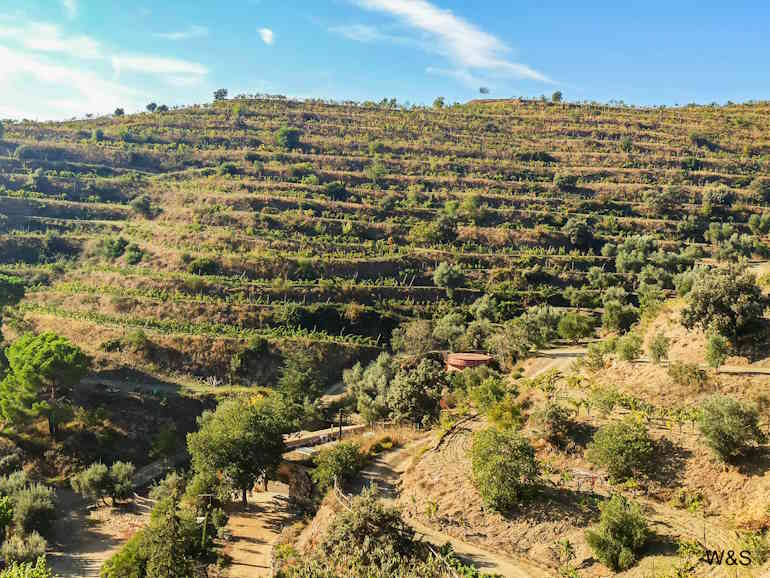
Irrigation is used in the vineyards. Without it, growing grapes in the conditions of Priorat would be impossible. Rainwater is collected for this purpose. During rainfall, water flows into large reservoirs installed at the foot of the hills. It is then pumped into other tanks located higher up the hills. From there, the water flows down to the vineyards by gravity.
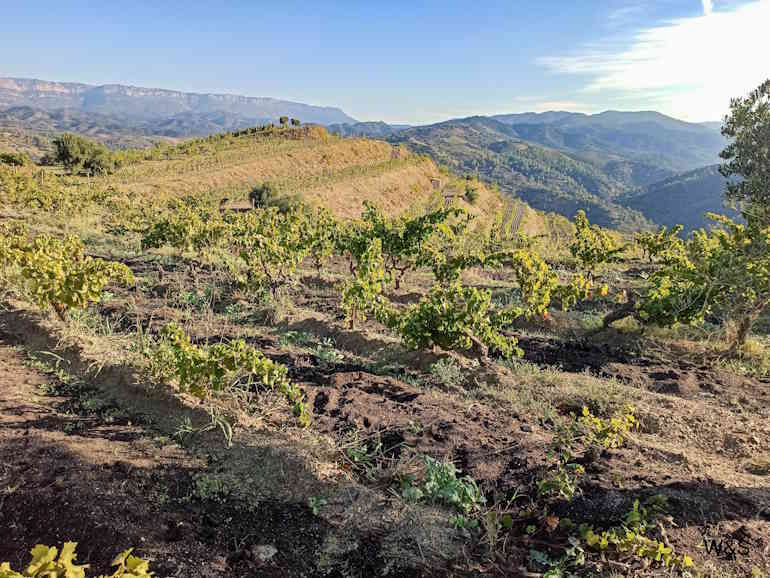
The vineyards cannot exactly be described as beautiful, but a tremendous amount of work goes into maintaining them. Most of it is done by hand.
The Harvest
According to Christian, yields in Priorat’s vineyards are very low, depending on the vineyard, for instance, in the slopes with old vines. For example, on slopes with old vines, yields can be as low as 2,000 kg/ha, while younger plantings can produce up to 5,000 kg/ha. In any case, the Regulatory body for the D.O.Q. Priorat has set up limits on the yields; in some cases, such “Vinyes Velles” (“Old Vines”), the maximum is 3.000 kgs/ha.
It is worth noting that it was the pioneers of Priorat’s revival who introduced yield restrictions. During the first harvests, local winegrowers could not understand why grapes with certain less-than-perfect characteristics had to be discarded in order to produce outstanding wine. For example, they did not consider underripe grapes to be a defect. Sometimes, you might harvest 1.8 kg of grapes from a vine and discard 700 grams of them. That is why, initially, it was necessary to keep a close eye on the local grape pickers.
While 12 people work permanently in the vineyards, “Clos Mogador” brings in around ten additional workers from Morocco and Romania during the harvest. They work here for a week. Five more employees from the office also come to help, because once the grapes ripen, they have to be picked very quickly. The bunches are harvested selectively and placed in small 10 kg crates to ensure careful transportation.
At the Winery
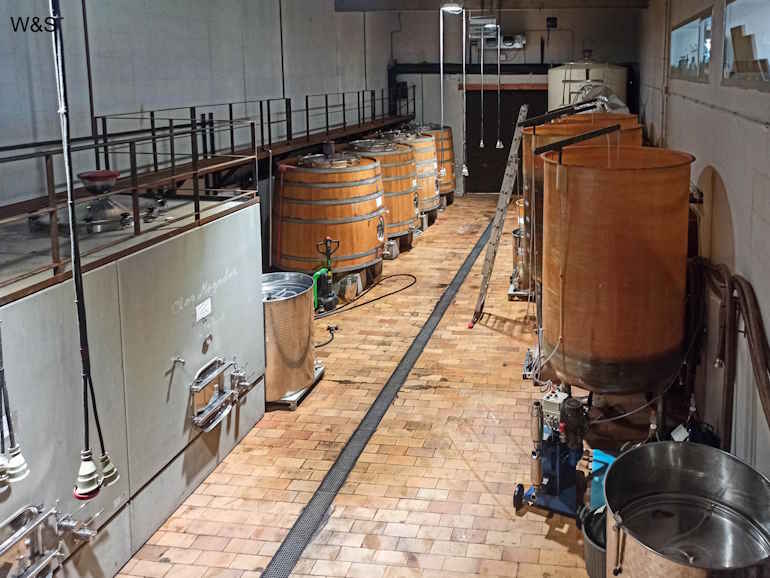
Before processing, the grapes are cooled in a cold-storage room. They then pass along a conveyor belt for bunch selection, followed by a vibrating sorting table where individual berries are sorted. Each wine is made using its own specific technology. Fermentation takes place in oak vats. The producer states that only natural yeasts are used. But does this mean that fermentation is spontaneous?
“We have been working with only native yeasts for nearly 10 years, and we do prepare a yeast culture beforehand, with grapes from the same plot that we are going to harvest, this works as a starter,” René Barbier Meyer replied.
One of the distinctive features of the winemaking process is that some grape varieties are processed together.
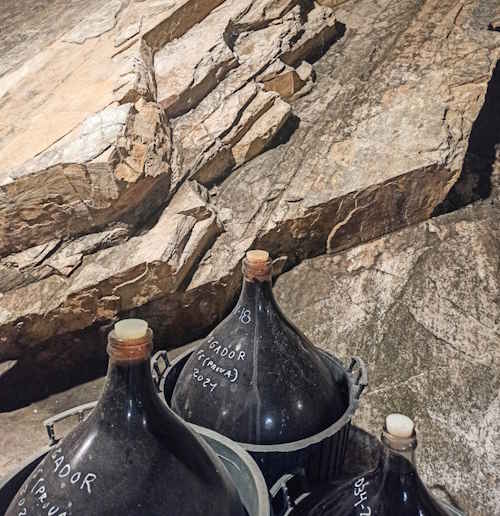
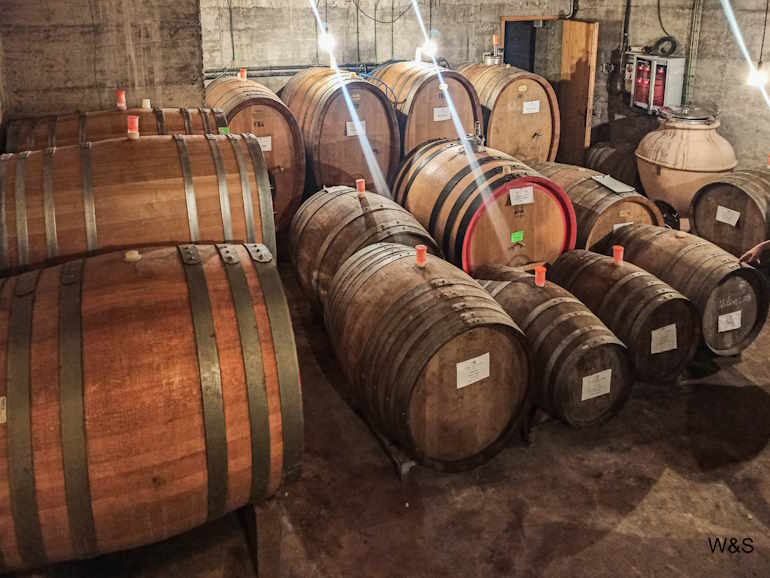
To create an underground wine cellar, the team had to excavate it directly into the slate rock. One of the walls has been left exposed, revealing the rock itself.
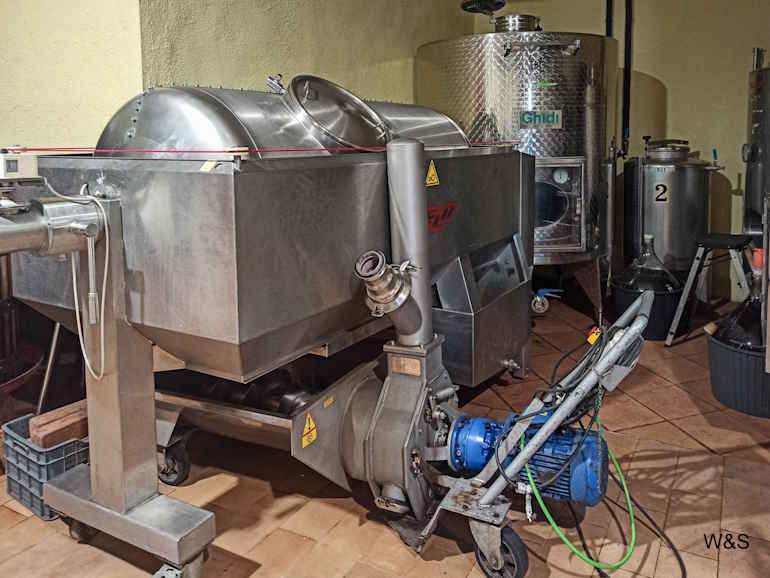
All kinds of vessels are used for winemaking: stainless steel, concrete, oak and clay.
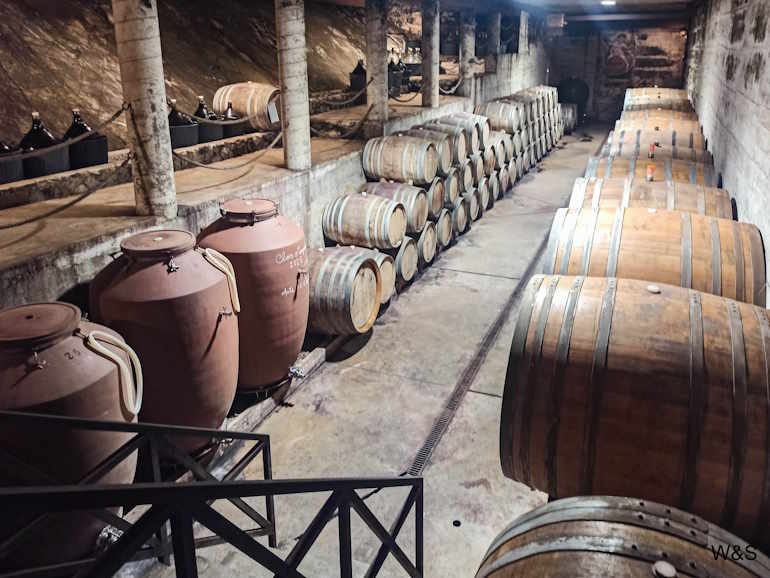
A separate, small room with several oak barrels is set aside for ageing white wines and rosé. There is also a corner with shelving containing a collection of old wines and glass demijohns in which experimental wines are stored.
In the grape reception area, alongside the conventional pneumatic press, there is a particularly interesting piece of equipment: an antique hydraulic press used for extracting olive oil or pressing grapes. It is more than 100 years old.
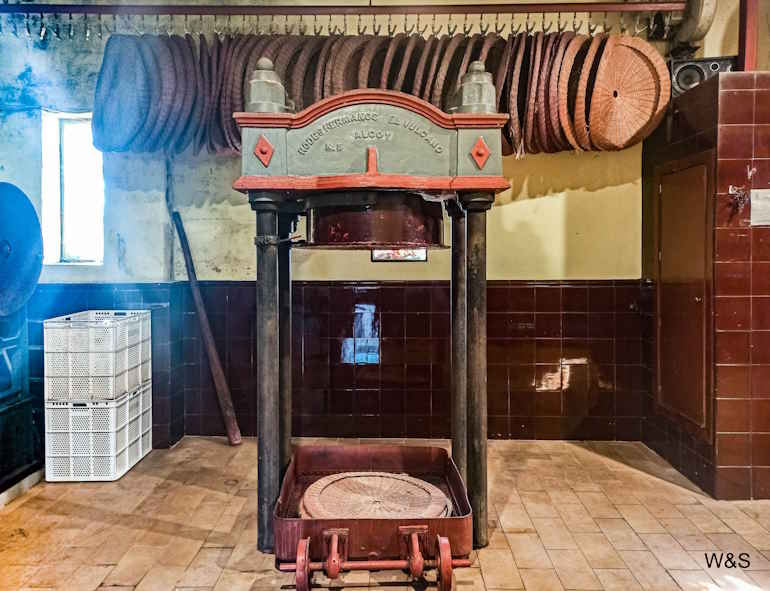
Special woven circular mats known as “capachos”, made from coconut fibre or esparto grass, hang from rods above. The crushed mass is placed in layers between these discs, forming a stack directly beneath the press piston. When pressure is applied, the system effectively separates the clean juice from the solid pomace. You can see how it works in this video.
I will have to write a separate article about the wines, as this one is already getting too long.
Beyond Wine
“Clos Mogador” produces a spirit made from grape distillate called “La Quina Essència”.
Olive oil is extracted from hundreds of olive trees planted among the vineyards along the terraces.
Beehives have been installed at the highest point of “Clos Mogador”. The bees help improve pollination of the vineyards, olive and almond trees, and other flowering plants, thereby increasing the biodiversity of the surrounding environment. The bees, in turn, benefit from a richer food source. Honey is harvested from the hives twice a year.
The estate also keeps sheep, which are moved between different plots before budbreak to help manage the ground cover. There are also mules, which are used to work the vineyard soil. Their manure is used to produce some of the fertilisers for the vineyards and the garden.
The estate also raises chickens. They are moved from one vineyard plot to another in a mobile chicken coop, allowing them to enrich their diet while their manure adds nutrients to the soil. The eggs are distributed among the workers and residents of the “Clos Mogador” community. Christian Barbier and his wife, Gisela Navarro, have established this community. Its members want to live in harmony with nature. They take care of the animals, pastures and garden.
The garden provides plants for phytotherapy preparations, as well as fruit and vegetables, which are distributed among the workers and community residents.
The Story Continues
In 2026, René Barbier Ferrer turned 76. He retired from “Clos Mogador” in 2022, handing over the management of the business to his sons. However, he remains involved in the production of “Espectacle del Montsant”.
In 1998, René Barbier, his wine importer Christopher Cannan, and another investor founded the “Espectacle Vins” project in the Montsant region (DO “Montsant”). The red wine “Espectacle del Montsant” is made from Garnacha Tinta grapes grown in a vineyard planted in 1900 (the vines are more than 125 years old!). For example, the 2022 vintage, which is currently on the market, received a score of 98/100 from Wine Advocate and 97/100 from Tim Atkin. This wine sells for prices starting at €103.
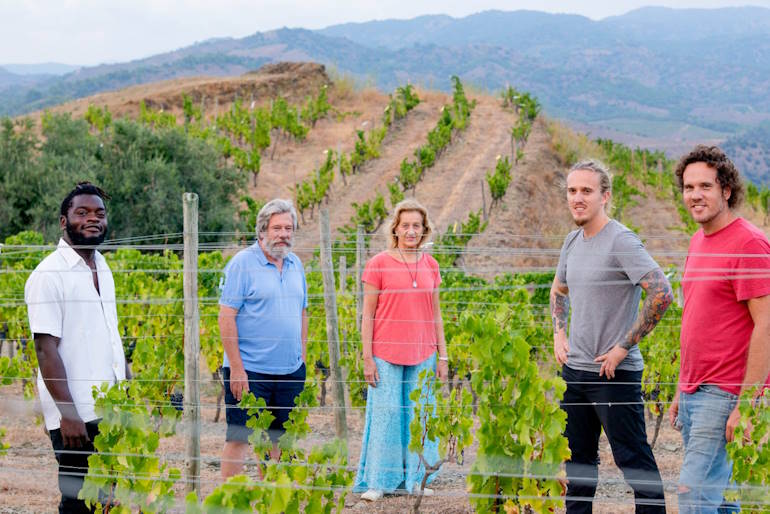
René’s wife, Isabelle Meyer, was an artist. At “Clos Mogador”, she was responsible for marketing and design. Sadly, she passed away in 2020.
René Barbier Meyer (the eldest son) – René IV is the winery’s director and head winemaker. He joined his father in 1992, when he was just 16, starting out as a wine salesperson at “Clos Mogador”. At the same time, René Jr. was studying at the wine school in Falset. He subsequently worked in Roussillon and the Loire Valley in France, Argentina, South Africa, and California. In 2002, René began making wines for “Clos Figueras”, owned by his father’s partner, Christopher Cannan.
René Barbier Meyer is married to Sara Pérez, the daughter of José Luis Pérez’s close associate (“Mas Martinet”), and they have four children. Together, they bought an abandoned vineyard in the Pesseroles Valley and restored it. They produce “Partida Pedrer”, “Dido”, “La Solució Rosa”, and “Bellvisos Blanc” wines.
The younger son, Christian Barbier Meyer (born in 1992), is responsible for agriculture. He, too, joined the family business at the age of 16, bringing with him a passion for environmental protection. This led him to study biodynamic viticulture at the Spanish Biodynamic Federation and at the Laboratory of Soil Microbiological Analysis in France.
In addition, in 2019, Christian and his wife, Gisela Navarro, launched their own biodynamic project, “Deunidó”, in La Figuera (Montsant region), where he also took on the role of winemaker. They produce two “Deunidó” wines: a red and an orange wine.
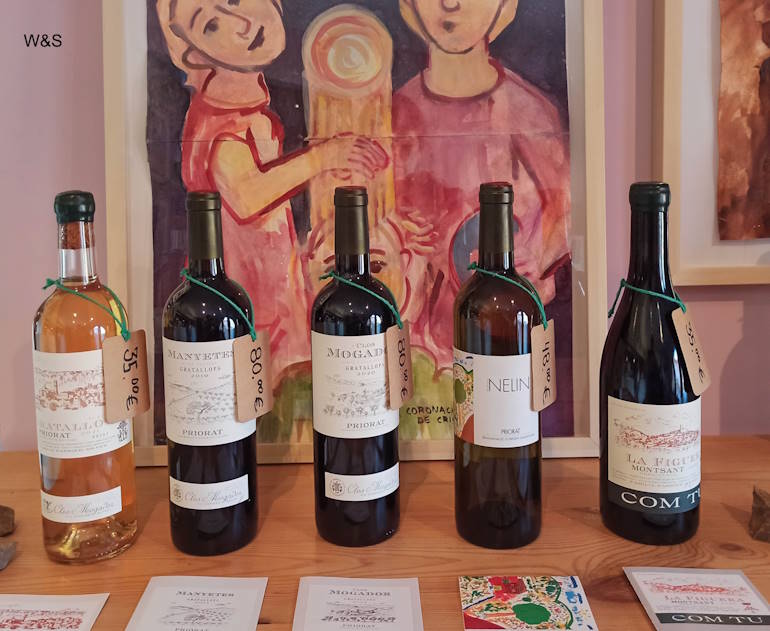
Anderson Barbier was born in Haiti in 1996 and was adopted by Isabelle and René at the age of four. He works in IT, but he, too, wanted to try his hand at winemaking. He came up with the “Com Tu” project in the Montsant region, which he developed together with his brothers and father. Anderson and Isabelle created a wine label filled with personal meaning: two faces of different races joined together to form one. In 2021, Anderson left the project. His brothers continue it, although they have changed the wine label.
The wines from all the projects, with the exception of “Espectacle del Montsant”, can be seen in this photo.
The founder of “Clos Mogador” is happy to have passed on his passion for winemaking in Priorat to his children. His sons are carrying on the work of his life. Both are pursuing careers as winegrowers and winemakers.
When René Barbier Ferrer and Isabelle Meyer arrived in this neglected corner of the world, they could hardly have imagined the impact their “adventure” in winemaking in Gratallops would have. Their passion and perseverance enabled them to conquer these slate soils under the scorching sun and bring them back to life. Thanks to them, the world fell in love with Priorat. René Barbier Ferrer became a legend alive in the wine world, and his “Clos Mogador” became an iconic winery.
P.S.: More photos accompanying the article can be found in the “Clos Mogador” album on the website’s Facebook page.
Related articles:
DOQ Priorat: From Abandoned Vineyards to Iconic Wines
