

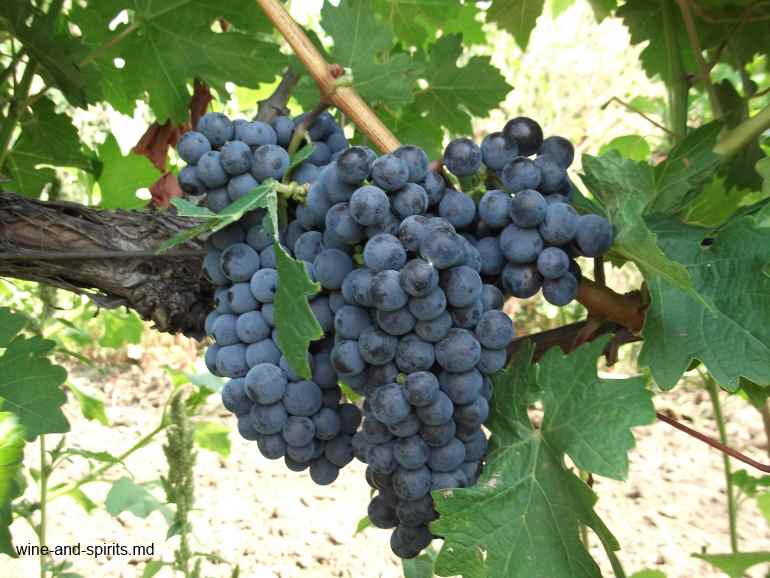
Feteasca Neagră (a Vitis vinifera variety) is an autochthonous grape originating from the region between the Carpathians and the Dniester River and is considered one of the oldest in Europe. In Moldova, it was undeservedly forgotten for a period, but in recent years its popularity has been growing.
From Wild Vines
It is believed to be an intermediate form of wild grapevine that has not survived to the present day. Such forms served as the foundation of the local assortment of grape varieties. A comparative analysis of seed parameters of several ancient local varieties (Feteasca Neagră, Negru Moale, Rara Neagră) and wild vines revealed a high degree of similarity. The parentage of the variety has not yet been established.
Depending on the region of cultivation, Feteasca Neagră has also been known under various synonyms: Fetească Neagră, Păsărească Neagră, Poama Fetei Neagră, Coada Rândunicii, and Coada Rândunicei. The name translates as “Feteasca Ciornaia” (Russian), Fekete Leányka (Hungarian), Mädchentraube Schwarz or Schwarze Mädchentraube (German), Fetyasca Black (English), and Qara Fetyasca, Pasaryaska Niaqra (Turkish).
The first documented mention of this variety was found in the travel notes of a Russian army officer who participated in the Austro–Russian–Turkish War (1787–1791). A trained botanist, he served as secretary for foreign correspondence in the office of Prince Potemkin and visited the region in the course of his duties. In his book, he described several local grape varieties, including Feteasca Albă and Feteasca Neagră.
In February 1940, in Romania (of which Bessarabia was a part from March 27, 1918, to June 28, 1940), a decision was made to include Feteasca Neagră in the list of red technical grape varieties permitted for propagation and cultivation. In 1971, it was entered into the Official Catalogue of Romanian Varieties, and between 2005 and 2009, seven clones were also included.
Undeservedly Forgotten
During the Soviet period in the Moldavian SSR, the variety did not receive sufficient attention. Doctor Habilitatus Gheorghe Savin (Scientific-Practical Institute of Horticulture, Viticulture and Food Technologies) explained why:
In the past, domestic scientists studied Feteasca Neagră only sporadically. Everything considered Romanian (although in fact this is a regional variety) was viewed with suspicion. By the time attitudes became more positive, the opportunity had already been missed—others had studied and propagated it. At that point, people became reluctant to even speak about it, because foreign colleagues would ask how many clones we had, since any variety must be divided into at least three clones to understand its nature. In different conditions, it behaves differently. The creation of clones should be part of the plan for improving and disseminating both traditional high-quality varieties and new ones.”
Revival Driven by Enthusiasm
Interest in Feteasca Neagră in Moldova began to revive thanks to Gheorghe Gaberi, owner of the nursery enterprise Vitis Cojușna, who persuaded Chateau Vartely to plant the first plantation of the variety in independent Moldova in 2008—covering 5 hectares.
In 2007, I first brought Feteasca Neagră vines into Moldova; at that time, even winegrowers had never heard of it,” recalls Mr. Gaberi. “I had to visit the Romanian Minister of Agriculture twice to obtain permission to purchase the vines. On January 1, 2007, Romania joined the EU, and Feteasca Neagră entered the European assortment. French producers bought three million buds, with almost all material destined for France. We established the first plantation in Moldova in Comrat for Chateau Vartely using green seedlings. That was when the idea emerged to apply a new technology for growing vegetative seedlings in trays. Later, we already had our own propagation material.”
As a result, Feteasca Neagră was admitted to production trials and was only included in the national Catalogue of Plant Varieties in 2015. It is classified as a mid-late ripening variety. However, depending on annual weather conditions and the growing zone, this period can vary significantly. For example, harvesting began on October 3 in 2017, on September 1 in 2018. And on August 30 in 2019 in central Moldova, while in the cooler Ungheni district it began on October 24. Sugar levels were nearly identical in both cases: 248 g/L in Speia and 242 g/L in Mircești. These data come from experimental plots of the National Office of Vine and Wine, located in three geographic regions of the country.
While Romania has around 3,000 hectares planted with Feteasca Neagră, Moldova had only 320 hectares registered as of December 2020. Vineyards are scattered across most of the country (except the far north), from Vulcănești to Mircești, across 87 plots with an average size of 3.7 hectares.
A New Approach
The industry institute is now addressing the previous lack of attention to Feteasca Neagră. In 2019, vegetative seedlings of a new clone were planted in a “pre-basic” biological category mother plantation (own-rooted), and in 2020, grafted planting material was established in a “basic” category plantation. The clone material was sourced from the institute’s long-standing collection, consisting of locally originating vines.
Last autumn, approximately one crate of grapes was harvested from the pre-basic plantation, and oenologists produced wine from it for study.
If we identify any valuable traits of the variety, particularly those better expressed, we will select them,” says Dr. Viktor Bondarchuk, Head of the Laboratory of Virology and Phytosanitary Control. “However, a clone must not simply be different. Clonal selection will continue as long as viticulture exists. Differences will always be found—cluster shape, for instance. During the 2000–2010 period, many clones were imported into Moldova from various wine-producing countries, but they were developed for those countries. Under our soil and climatic conditions, results were inconsistent. Therefore, whether there is one clone or five is less important than whether they differ in economically valuable traits. For us, important factors include color intensity, cluster density, and ripening time. Clones cannot be judged as better or worse—each is suited to specific types of wine.”
Varietal Characteristics
According to Dr. Mihail Kukharsky, vines of this variety are medium to vigorous in growth, with high resistance to drought and frost (down to −22 to −24°C). Feteasca Neagră shows moderate susceptibility to downy mildew and low susceptibility to other diseases and pests. The growing season lasts 125–140 days with a sum of active temperatures of 2700–2800°C.
Clusters are cylindrical or cylindro-conical, with tightly packed berries. The average cluster weight is 110–150 g. The berries are round, medium-sized, with a thick, durable skin of violet-black color covered by a waxy bloom. The pulp juice is colorless. Wines produced are deeply colored, with an intense ruby hue.
Yield ranges from 9 to 14 t/ha, with sugar content of 220–240 g/dm³ and acidity of 6–7 g/dm³ or higher. Yields can reach 15–20 t/ha through increased vine load and longer pruning (8–10 buds). Grapes can remain on the vine for an extended period without rotting. Shoots ripen well. The variety demonstrates strong regenerative capacity and does not require winter covering. Rootstocks include R × R 101-14, B × R Kober 5BB, and B × R SO4.
For optimal fruiting, the variety requires balanced vine load and pruning length, depending on shoot vigor and intended use. Cordon and fan-trained systems on medium trunks are preferred. Currently, low-volume systems such as double Guyot and Royat are also being tested under different planting densities.
For improved berry coloration and anthocyanin accumulation, cultivation on clay and heavy loam soils is recommended.
P.S.: Read about the wines produced from Fetească Neagră in Moldova in the next article.
Related articles:
Feteasca Neagră Wines in Moldova
