

Moldovans have established the highest-altitude vineyard in the Northern Hemisphere, at 7,200 feet (2,194 metres) above sea level in Colorado Springs (Colorado, USA). They also plan to build a winery there. Until now, the highest-altitude commercial vineyard in the Northern Hemisphere has been Stone Summit Vineyard in California, located at 6,750 feet.
But the most interesting thing is that, for the new record holders, Sergey and Daniela Botsolin, viticulture and winemaking are a great passion, yet still a hobby, since both are practising surgeons. Sergey Botsolin tells us how this fits together.
– How did you end up in the United States?
– I graduated from medical school and completed my residency in orthopedic surgery. After that, in 2001, I moved to the United States to pursue postgraduate studies and earn my doctoral degree. My wife Daniela had also graduated from medical school. Two months after I left, she came to America with our five-year-old son. In the U.S., we retook all the exams in order to obtain a license to practice medicine there.
We entered and completed our postgraduate studies; I defended my dissertation and received a doctoral degree. Then we completed a residency. Dana did hers in general surgery in Washington, while I repeated my residency in Denver, Colorado. In the United States, this takes five years, compared with three years in Moldova. After that, I spent another year completing a specialization in spinal surgery at Johns Hopkins University in Baltimore, Maryland.
We completed our training in 2016. I entered the Chisinau Medical Institute in 1991 and became a fully qualified surgeon in the United States in 2016. It took me exactly 25 years to reach my professional goal, 15 of them spent in the United States. We found jobs in Colorado Springs. I became a spinal surgeon, while Daniela works in general and trauma surgery.
– Where did your love of grapes and wine come from?
– For me, it goes back to childhood. Although both my parents were doctors and lived in Chisinau, they grew grapes at their country house. I developed a love of winemaking thanks to my mother’s elder brother, Vasily. He lives in the village of Gorodishte and has always made delicious wines in the old Moldovan tradition.
Uncle Vasya grows grapes, including local varieties, using an old Moldovan training system called the Moldovan goblet on stakes. Starting at the age of five or six, I would go into the forest with the adults to collect tree branches that were used to make stakes for the vineyard. The vines were trained on stakes rather than trellises.
At first, my cousins and I were allowed to pick up grapes from the ground. When I grew older, we were allowed to harvest grapes alongside the adults. For me, that was a very important milestone.
Uncle Vasya and our other relatives make white wines by fermenting the grapes on the skins. After two or three weeks, they rack the wine off and press the pomace. They make only a small quantity, around 40–50 litres, of white wine fermented without the skins, reserving it for special occasions.
My interest in grapes as a subject of study, including reading books about them, developed only after I came to America. Until 2016, Dana and I had never lived in one place for more than two and a half years. At first we lived in Michigan, then in Colorado. Nevertheless, at some point I bought large planters and grew a couple of grapevines in them. Studying grapevines became my hobby. However, my great love of grapes was inspired by a painting. It is called “Summer Picnic”, and there is a story behind it.

– Tell us the story.
– The period of study was very complex and difficult in many respects. Our official contracts required us to work 80 hours a week, that’s a lot Moreover, because Dana was doing her residency in Washington and I was in Denver, we lived apart for three years. Pasha stayed with me.
One night, I was called to see a patient on the fourth floor of the hospital. Afterwards, I decided to return to the residents’ room by taking the stairs rather than the lift. On one of the landings, I noticed a small painting, took a picture of it and sent it to Dana. From then on, whenever things became really difficult, we would look at that painting and imagine it as the future we wanted to create. Admittedly, we did not plan to become quite such chubby people as those depicted in it, but the underlying idea was exactly right.
That painting was where it all began. It put us on a straight path. We had a clear goal that we wanted to achieve. Of course, our future would not look exactly like the scene in the painting. We were not in California, or even Virginia, where grapes are grown and wine is made. Nevertheless, the painting captured our desire and our dream. It helped us get through the difficult years, and it now hangs in our house. Reproductions are available on Amazon.
In 2016, we completed our training and found jobs. In October, we acquired our own house and 20 hectares of land. The previous owners had built the house and raised alpacas for their fleece. They had a herd of 104 animals.
When we viewed the house and property, we liked the fact that the previous owners had been collecting the animals’ manure in one place for 12 years. We realized that this was “gold”, and it was one of the decisive factors in our choice.
We raise sheep and goats of meat breeds. We have 30 animals in total. Many of our acquaintances say it is the tastiest meat they have ever eaten. It is organic because the animals feed exclusively on what grows on our land. The property is divided into five pastures, and the herd spends two weeks grazing on each one.

– How did you choose the site for your vineyard?
– Before planting the vineyard, I carried out a great deal of research. During our first winter, I observed the sun and the winds. Our plot is located at an altitude of 2,194 metres above sea level, which creates certain unfavorable conditions for growing agricultural crops.
Officially, our land is classified as a high-altitude semi-desert. First of all, there is very little precipitation, up to 400 mm per year. Moreover, it is highly irregular, so drip irrigation is necessary.
Second, from October until May or June, we have very strong winds, sometimes reaching 90 miles per hour (145 kilometres per hour). When the previous owners bought the property in 1994, they consulted specialists and found a way to reduce the impact of the winds from the northwest. They planted six rows of vegetation at right angles to the prevailing wind, starting with shrubs and progressing to pine trees, with each row taller than the one before it.
Taking these conditions into account, I chose a site for the vineyard where the wind would have the least possible impact while the vines would receive plenty of sunlight. I believe there are also advantages that could help us produce a good grape harvest and interesting wines.

– What are those advantages?
– The first is the high level of ultraviolet radiation. Because we are so far above sea level, solar radiation is intense here. Ultraviolet rays affect the grapes by increasing the levels of anthocyanins, resveratrol and tannins in the berries.
The second advantage is the difference between daytime and nighttime temperatures. In summer, temperatures rarely reach 30°C, while at night they always fall to 12–13°C. This is a mountain climate. We have three wood-burning stoves and one air conditioner in the house, which we have not switched on even once in six years. The lowest winter temperature is minus 26°C, usually for two or three nights in February. But sometimes temperatures can reach as high as 20°C in January.
The third advantage is the constant breeze, which keeps humidity low. Atmospheric humidity ranges from 10 to 30 per cent, so the air is dry. All this allows me to grow grapes without chemicals because there is little risk of disease. Downy mildew, for example, requires humidity, stagnant air and high temperatures. Here, the air is dry, it is not excessively hot, and everything is well ventilated.
The fourth factor is that our soil is not particularly fertile. It has never been cultivated. We have volcanic soils, with a neutral pH in some places and alkaline soil with a pH of 7–8 in others.
I plant the vines using a tractor and a large auger. I drill the holes, put two buckets of alpaca manure into each one, mix it with the soil and prepare the planting hole. Using this method, we have planted 360 grapevines.
– Which grape varieties have you chosen?
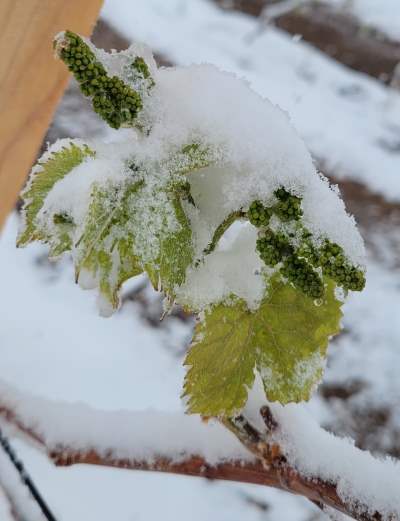
– In our mountain conditions, we have only 124 frost-free days, which is very little. Last year, on May 22, a major storm brought 20–30 cm of snow, and the temperature dropped to zero. The first frosts usually begin between September 21 and 25. Two years ago, we had a snowstorm on September 7.
That is why I am still experimenting with different grape varieties. I want to find varieties that bud late, no earlier than May 20, so that the vines do not freeze; varieties that can ripen within 120 days; and varieties that can produce good wine.
In the spring of 2017, we planted our first three rows, with eight vines of each variety: Valiant (from the Isabella group, considered one of the most cold-hardy varieties), Itasca, La Crescent, and La Crosse.
Later, we planted Frontenac, Frontenac Gris and Frontenac Blanc, but the Gris and Blanc didn’t catch on. We also have the white varieties Aurora, La Crescent Blanc and Prairie Star, as well as the red varieties Marquette, Maréchal Foch, Landot Noir, Oberlin Noir, Léon Millot, Sabrevois, Chelois, Regent and Golubok. We also grow one table grape variety, Somerset Seedless.
I have a polytunnel covered with plastic film where I grow European varieties that I do not think would survive outdoors here: Pinot Gris, Rondo, Solaris, Muscat of Norway and Pinot Noir Précoce.
I participate in an online forum with well-known grape growers and breeders. I have some varieties that they developed. My dream is to learn how to cross grape varieties in two or three years.
– How do the vines cope with such harsh conditions?
– The winds dry out the vines. For two consecutive years, I have covered them for the winter, following the method used in northern Moldova. I even train the bushes according to the Moldovan low-trained, trunkless system.
In October, I lay the vines down, and in November I cover them with mulch. I specifically bought a machine for shredding wood waste to produce the mulch.
Last winter, I left two Frontenac vines uncovered, and they survived. This year, I may leave more Frontenac vines uncovered, along with some other varieties. If they survive, I will not have to spend so much time covering the vines.
I begin uncovering the vines at the end of April or on May 1. This year, they came through the winter well and started budding, but then the snowstorm arrived on May 22 and damaged the buds.
There are clusters now, but they have developed from dormant buds. Golubok produced only one cluster because European varieties rarely produce clusters from secondary buds.
– Rara Neagră is grown in the United States. Have you tried planting it?
– I could not find a nursery where I could buy it. About 12 years ago, I contacted the grandson of Konstantin Frank, who brought Rara Neagră to the United States, and asked him to sell me a couple of cuttings, but he refused.
Unfortunately, Moldovan grape varieties are not suitable for our current conditions because the growing degree-day heat accumulation in our area is only 1,800 degrees Fahrenheit, calculated from April 1 to November 1, or approximately 1,000 degrees Celsius. That is far too little.
I look at what is grown in Washington and Oregon, where temperatures are also relatively low. I bought Golubok, Muscat of Norway and Pinot Noir Précoce from growers there because these varieties ripen at 1,600°F, which means they might ripen here as well.

– When will you be able to process your first grape harvest?
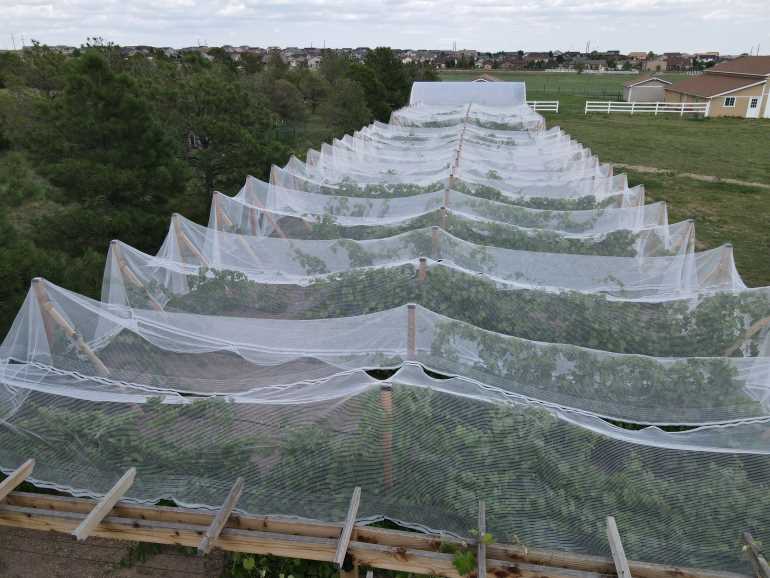
– Our area experiences at least one or two severe hailstorms every year. In 2020, a storm destroyed our vineyard. The vines began growing again from their roots. We had to buy hail-protection netting.
We cover the vineyard with the netting in May. This year, a severe hailstorm struck on June 4, but fortunately, the netting saved the vines. This year, we have a chance to process our first harvest.
Growing grapes here is not easy. Apart from the climatic factors, there is another problem: wild animals. Antelope, deer and hares come into the vineyard. During the first year after we planted the vines, deer ate the bushes three times. A three-metre-high fence is no obstacle for them.
We solved this problem by bringing two enormous Bucovina Shepherd Dogs from Romania. Their kennel is located in the vineyard.
At the moment, however, our biggest problem is birds. There are so many of them, and their sensors are remarkably sophisticated… Golubok began changing colour on August 4. Of the single cluster that survived the hail, the birds have already eaten a third. We are trying to use the hail-protection netting against birds as well.
Because I grow the vines according to the traditional Moldovan winter-covering method, they are quite close to the ground, and some clusters even lie on the mulch. The warmth from the soil helps the grapes ripen, but it also makes them easy for birds and hares to eat.
So, there are a great many challenges. But, as the saying goes, where there is a will, there is a way. For five years, we have been trying to find suitable varieties and grow grapes successfully. I have identified the varieties that overwinter well. Now I am selecting those that will ripen. After that, I will work on selecting varieties that can produce good wine.
– Have you built your cellar?
– Yes. We built a traditional Moldovan cellar and, in front of its entrance, a Moldovan-style tasting room called “Casa Mare”, as is customary in every Moldovan village.


We wanted to build the cellar deeper, but the structural features of the house did not allow it. There is a layer of soil 50–60 cm thick above the cellar. In summer, the temperature does not rise above 15–16°C, and in winter it does not fall below 3°C.
Pasha and I also built and installed a pergola in the yard ourselves. We built an oven underneath it, where we bake vertuta, a traditional Moldovan pastry. In short, we have created a little corner of Moldova here in Colorado.
– But you started making wine in America earlier than that…
– In 2004, when we were living in Michigan, which ranks ninth among US states in terms of the amount of grapes grown, we were studying in graduate school and found a farm where customers could pick their own grapes.
We borrowed a minivan from a friend, rented plastic crates and went to pick Concord grapes, which belong to the Isabella group. The three of us, including our eight-year-old son, finished the job in an hour and a half.
The farmer did not weigh the grapes because he assumed that we could not have picked much in such a short time. He charged us for 100 kilograms. When we weighed the grapes at home, we discovered that we had actually picked 170 kilograms. We rented some of the equipment needed for winemaking and bought the rest, and we made our wine.
Our first wine in our own house in Colorado Springs came in 2017. We make wine every year, but we buy the grapes. For the first two years, we bought them from western Colorado, on the other side of the mountains from us. For the past four years, we have bought them in California. I have already received a message asking us to choose and order grapes from the coming harvest. They will deliver them to us.
– How do you make your wine?
– We have bought a crusher, a press and 200-litre stainless-steel fermentation tanks. We usually buy six varieties: three white – Chardonnay, Viognier and Pinot Gris, and three red – Cabernet Franc, Cabernet Sauvignon and Pinot Noir.
All the wines ferment on the skins for 12–14 days. I even age the white wines on the skins. That is how my grandfathers and uncles used to make wine. I do not add sulphites.
Before fermentation has completely stopped, I transfer the wine into 25-litre glass demijohns because it is still producing carbon dioxide, which protects it against oxidation. The demijohns are stored in the cellar.
Once the wine has clarified, I rack it into another demijohn. Then I transfer it into 20-litre and 10-litre bags designed for “bag-in-box” packaging. These bags make it easy to pour the wine, prevent air from entering and protect the wine from oxidation.
Last year, we produced 240 litres. We still have some wine left from the previous year, and it has kept very well.
Many people taste our wines and really enjoy them. Gradually, our winemaking season is turning into a mini-festival. Many friends and acquaintances want to take part in processing the grapes.
Our crusher was originally manual. I deliberately chose not to buy an electric one because I wanted the process to resemble the way things were done in Moldova in the old days. For the first four years, my shoulder hurt from turning the handle. Last year, I converted the crusher to a pedal-driven mechanism. More and more people now want to pedal, and we treat them to wine.
We also give our wine to colleagues at work. For gifts, we package some of it in 0.75-litre bags. Dana writes attractive labels for them, and everyone is delighted.
Many people who have tasted our wines say they do not get a headache afterwards. In addition to not using sulphites, we do not age our wines in oak because many people dislike the presence of oak tannins.
– You seem to be approaching the point where you can move from experimentation to production. What are your plans?
– Wines made from Californian grapes are certainly good, but my dream and my goal are to make wine from the land we live on.
For me, wine is the taste of the earth. A grapevine produces different wine flavours in different parts of the world. I really want to discover the taste of our land in our wines.
As an acquaintance of mine who grows grapes in Colorado says, everything depends on why you are doing it. People even grow grapes in greenhouses in Alaska and make wine from them. In theory, you can grow grapes wherever you want. The real questions are how much it will cost and what kind of quality you will achieve.
Once we determine which grape varieties produce the best wines here and begin making them as a winery, we will call the wines “7200 White” and “7200 Red”. The figure of 7,200 feet refers to the altitude of our location. We named our farm “Spines and Vines” because I want to be good at two things: spinal surgery and growing grapes.
Dana has a dream of her own. If we succeed in making good wine, our vineyard could officially become the highest-altitude organic vineyard in the Northern Hemisphere.
– I wish you success in achieving your most ambitious plans! I hope to write the next chapter of your story in the near future.
